

Public Domain Status Floats New Projects
Spinach-addicted muscled mariner Popeye has sailed into uncharted waters. As of January 1, 2025, Popeye the Sailor Man is now in the public domain, meaning his copyright has expired, and the character is free to adapt or completely reimagine. If history is any guide, we’ll soon see some wild takes on the man who famously declared, “I yam what I yam.”
Introduced as a side character in American cartoonist E. C. Segar’s “Thimble Theater” strip, which began in New York’s Evening Journal in 1919, Popeye wouldn’t debut until a decade later in 1929. The strip’s popularity soared with his seaside shenanigans (perpetually wooing the already extant Olive Oyl, brawling with Bluto). National and then international syndication followed. This first iteration of Popeye is now public domain, much like the “Steamboat Willie” version of Mickey Mouse went public domain last year.

But it’s what’s on Popeye’s horizon that’s of most interest to me. Remember what happened when Winnie-the-Pooh entered the public domain in 2023? Pooh Bear didn’t just don a red shirt—he grabbed a machete. Winnie-the-Pooh: Blood and Honey, the slasher reimagining, gave us a bloodthirsty Pooh and Piglet in a woodsman-meets-berserker rampage. The critical reception was abysmal, but it made money, honey. Grossing $7.7 million worldwide on a $100,000 budget, the film proved that nostalgia and shock value make a potent mix.
Pass the Spinach
Predictably, at least three horror films featuring the sailor are reportedly in the works, with titles like Popeye the Slayer Man and Popeye’s Revenge. Expect nautical nightmares, grotesque musculature, and spinach-fueled rampages. While Popeye’s original 1929 incarnation is fair game, his trademarks remain tightly held by Hearst Holdings (yes, Citizen Kane still owns the rest of Popeye). This means indie filmmakers must tread carefully to avoid a legal scuffle.
Most of my generation knows Popeye from the cartoons that ran nonstop as after-school broadcast filler through the 70s and early 80s. As the Federal Communications Commission (FCC) began cracking down on depictions of violence in children’s programming, Popeye, a sailor first but a pugilist in close second, began to fade from the airwaves.
I’ve always preferred the older black-and-white Popeye cartoons, which leaned into Segar’s eccentric world-building. From the Sea Hag sorceress ruling Goon Island to Wimpy’s perpetually deferred payments, these episodes captured a surreal maritime mythos that modern adaptations often lack. For example, Goon Island is ruled by the Sea Hag, whose minion, Alice the Goon, is a bald, hairy giantess with a big nose whose spoken words appear as squiggles only intelligible to Wimpy. Fortunately, Popeye liberates her (so she can babysit Swee’Pea)

Director Robert Altman’s 1980 live-action adaptation likewise stayed close to some of this world-building (the world he built is still standing in Malta and is a popular spot for weddings). Altman, however, eschewed much of the original character and story elements despite having such brilliant actors as Robin Williams and Shelley Duvall at his disposal. The upcoming adaptations (using that word more loosely than Wimpy’s promise to pay you Tuesday for a hamburger today) seem to dispense with everything but the title and the sailor’s prognathism-afflicted* silhouette. (That’s my new word today. Prognathism is a condition where the lower jaw protrudes beyond the face).
Here’s the logline of one upcoming Popeye flick: “A curious group of friends sneak into an abandoned spinach canning factory to investigate the legend of the ‘Sailor Man,’ who is said to haunt the factory and local docks.” Let’s presume chaos ensues.

The possibilities for Popeye, however, extend far beyond horror. His entry into the public domain is an open invitation for storytellers to reinterpret his world. Why all this blood and leafy greens? Why not a gritty origin story that explores his early days on the docks (he could’ve been a contender)? Or a screwball rom-com about meeting Olive Oyl whilst on shore leave? Or perhaps a poignant drama reframing Popeye’s mantra, “I yam what I yam,” as a meditation on self-acceptance?
Lost at Sea
But filmmakers take heed—thar be monsters when mixing Popeye and cinema. According to WBUR’s Sean Burns, the reception of Altman’s film was apparently “so toxic…Altman was left unemployable and exiled to Paris, directing micro-budgeted indie theater adaptations for the remainder of the decade.” Which, frankly, would be a step up for most of us.
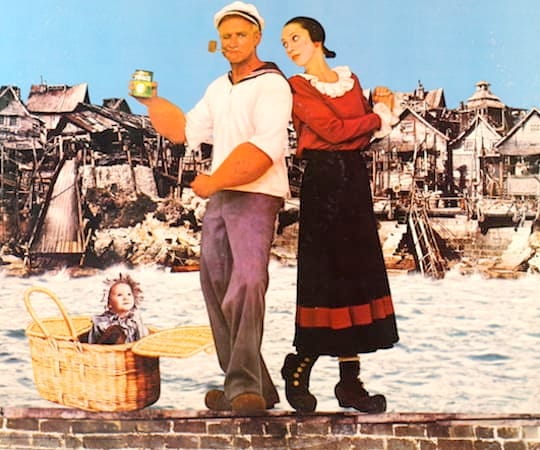
Keeping an eye on the horizon, we’re seeing the creative potential of fresh takes on old stories as more cultural icons become legally available to creatives. Whether Popeye’s next adventure is a cinematic shipwreck or a surprise hit, it’s a reminder that art and IP sink or swim together in this business.


Share Your Thoughts